
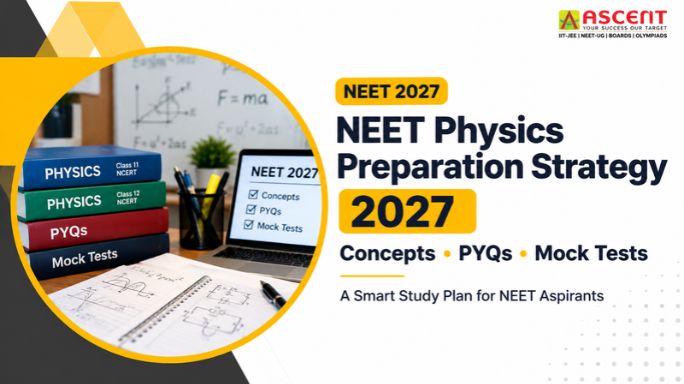

Ask any group of medical aspirants which subject keeps them awake at night, and most will name physics. Biology rewards memory and chemistry rewards a mix of recall and logic, but physics asks you to understand a situation, choose the right principle and then calculate quickly without a slip. That combination is exactly why a clear NEET physics preparation strategy 2027 matters more than the number of hours you sit with a book.
The good news is that physics in NEET is far more predictable than it feels. The questions come from NCERT-level concepts, the same chapters repeat every year, and the traps examiners use are limited. Once you see the pattern, the subject stops being a fear and becomes a scoring area. This guide breaks the plan into three pillars: concepts, previous year questions (PYQs) and mock tests, followed by a month-by-month timeline you can start using today.
Why Physics Decides Your NEET Rank
In the recent exam pattern, physics carries 45 compulsory questions worth 180 marks out of 720. Each correct answer earns four marks and each wrong one costs a mark.
Compulsory Questions
Marks out of 720
Each Correct Answer
Each Wrong Answer
Because most serious aspirants score close to each other in biology — especially those following a NCERT-based NEET Biology preparation strategy — the real gap in rank often opens up in physics. A student who moves from 100 to 150 in physics can jump thousands of ranks without changing anything else.
There is also a time angle. Physics questions take longer to solve than biology questions, so a weak physics section eats into the time you need for the rest of the paper. A strong physics base gives you marks and minutes at the same time.
💡 Quick note: Always confirm the final pattern and syllabus in the official NTA information bulletin for NEET 2027 once it is released, and adjust your plan if anything changes.
Pillar 1: Build Concepts the Right Way
Every good NEET physics preparation 2027 plan starts with concepts, not with question banks. Jumping straight into hundreds of MCQs without understanding the theory only builds confusion and guesswork. It also helps to understand how NEET physics differs from JEE physics, so you invest your effort at the right depth.
Make NCERT your foundation
NCERT Class 11 and Class 12 physics textbooks define the scope of the exam. Read each chapter line by line, including the examples, the boxed points and the end-of-chapter exercises. Many NEET questions are direct applications of a statement or derivation hidden in an NCERT paragraph. The syllabus now also includes an experimental skills unit, so pay attention to practical topics such as the screw gauge, vernier callipers, the meter bridge and the simple pendulum.
Learn the “why” behind every formula
Instead of memorising a formula sheet in isolation, ask three questions for each formula: where does it come from, under what conditions does it apply, and what happens at its limits. For example, knowing why the time period of a simple pendulum does not depend on mass helps you eliminate wrong options instantly.
Keep a personal formula and mistake notebook
Maintain a slim notebook with two sections. The first holds formulas, units and dimensions chapter-wise. The second records every mistake you make, along with the reason: a sign error, a wrong assumption or a concept gap.
Prioritise high-yield chapters
All chapters matter, but some consistently carry more questions. Give extra depth to these units:
🎯 High-Yield Physics Units
Modern physics and semiconductors deserve special mention. They are shorter, largely theory-based and often produce easy marks, so finishing them early gives you a reliable cushion.
Pillar 2: Use PYQs as Your Practice Compass
Previous year questions are the closest thing you have to the examiner’s mind. Solving them is not optional; it is the second backbone of any serious NEET Physics study plan 2027.
How to solve PYQs smartly
Spot the patterns
As you work through PYQs, you will notice recurring question styles: graph-based questions in kinematics, ratio questions in gravitation, circuit simplification in current electricity and statement-based questions in semiconductors. Note them down, because recognition saves precious time in the exam.
Do not memorise answers
A common mistake is to repeat the same PYQs until the answers are remembered. That gives false confidence. Instead, change one value or one condition in the question and solve it again. If you can handle the twisted version, you have truly learnt the concept.
Pillar 3: Mock Tests That Actually Improve Your Score
Mock tests turn knowledge into exam performance. They build speed, test your accuracy under pressure and train your brain for a three-hour paper.
When to start
Begin with chapter tests and part-syllabus tests from the early months. Shift to full-length mocks once around 70 to 80 percent of the syllabus is complete, ideally by January or February 2027. In the final two months, take two to three full-length mocks every week.
Analysis matters more than the test
The real benefit of a mock test comes after you submit it. Spend at least as much time analysing a paper as you spent writing it. Use a simple table like the one below after every mock (swipe sideways on mobile):
Build an exam-day attempt order
Mock tests are the place to experiment with strategy. Many students find it useful to do a quick first round in physics, attempting only questions they can solve in under a minute, and then return for the longer ones. Find the order that works for you and lock it in well before May.
Month-by-Month NEET Physics Study Plan 2027
Here is a practical timeline assuming you are starting from October 2026 and the exam falls in early May 2027, as it usually does. Adjust the months according to your own syllabus coverage.
Focus: Complete remaining chapters with NCERT and topic-wise practice
Target: Full syllabus covered once, chapter-wise PYQs done
Focus: First full revision, mixed PYQ sets, weekly part tests
Target: Formula notebook finalised, weak chapters identified
Focus: Full-length mocks, error analysis, targeted revision
Target: 2 to 3 mocks per week with detailed analysis
Focus: Light revision, formula notebook, mistake notebook
Target: Calm mind, sharp recall, no new topics
This NEET Physics study plan 2027 works for both Class 12 students and repeaters. If you are in Class 12, balance it with school board preparation by covering board-style derivations alongside MCQ practice, because both reinforce the same concepts.
Common Mistakes to Avoid
These slip-ups quietly weaken NEET physics preparation 2027 for many students:
Tips for Repeaters and Hindi-Medium Students
If you are attempting NEET again, start by honestly reviewing last year’s physics performance. Identify the chapters where you lost the most marks and rebuild them from the basics before moving to advanced practice. For Hindi-medium students, the same NCERT content is available in Hindi, and the exam paper is bilingual. Keep the technical terms in both languages in your formula notebook so that wording never becomes a hurdle.
How Expert Guidance Helps
Self-study is powerful, but structured guidance speeds it up. Experienced faculty can explain tricky chapters in simpler ways, regular tests keep you accountable, and doubt sessions stop small confusions from becoming big gaps. Daily practice problems and well-organised study material also save you hours of searching for the right questions. If you are in or around Udaipur, joining a classroom NEET programme in Udaipur with a strong testing system can make your NEET physics preparation strategy 2027 much more disciplined and measurable.
Frequently Asked Questions
How many hours should I study physics daily for NEET 2027?
Most aspirants benefit from three to four focused hours of physics each day, split between theory, practice and revision. Quality and consistency matter more than raw hours.
Is NCERT enough for NEET physics?
NCERT is essential for theory and covers the scope of the exam, but you also need regular MCQ practice, PYQs and mock tests to build speed and problem-solving skill.
When should I start full-length mock tests?
Start once most of the syllabus is complete, ideally by January or February 2027, and increase the frequency in March and April.
Final Word
Physics rewards students who are steady, not those who panic. Build concepts from NCERT, let PYQs show you what the examiner values, and use mock tests to sharpen speed and accuracy. Follow this NEET physics preparation strategy 2027 with honest weekly reviews, and the subject that once felt like a hurdle can become the section that lifts your rank.
Ready to turn physics into your scoring section?
Join a guided NEET programme with expert faculty, daily practice, and a structured testing system.