

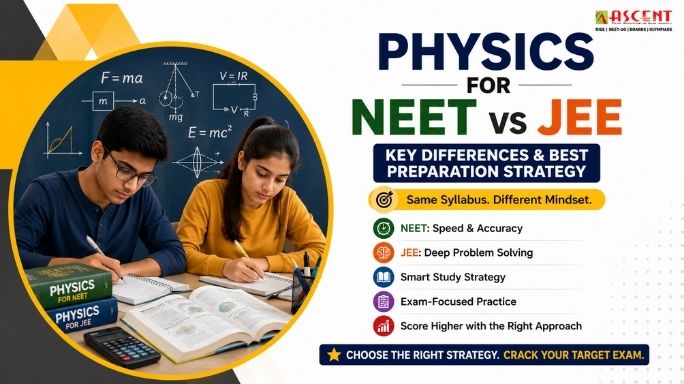

Two of the country’s most competitive entrance tests draw from the same core science, yet they reward almost opposite skill sets. Grasping Physics for NEET vs Physics for JEE early in your journey can save you months of misdirected effort — because the way you practise should be shaped by the exam you are actually sitting, not by a one-size-fits-all routine.
Same Syllabus, Two Very Different Battles
On paper, the topic list overlaps heavily — mechanics, thermodynamics, electromagnetism, optics, and modern physics. A student glancing at both syllabi might assume one preparation plan covers everything. That assumption quietly costs ranks every year.
The real Difference Between NEET and JEE Physics is not in what you study but in how deeply and how fast you are expected to apply it. One exam rewards quick, confident recall of standard results; the other demands layered reasoning where a single question can fold three concepts into one problem.
How the Two Exams Test You Differently
The clearest way to see the gap is side by side. The table below maps how the same subject behaves under each format:
| Aspect | In the Medical Exam | In the Engineering Exam |
|---|---|---|
| Question Style | Direct, mostly single-concept and formula-based | Multi-step, application-heavy, often involving multiple concepts |
| Difficulty Level | Moderate, closely tied to the textbook | High, especially at the advanced level |
| Numerical Depth | Light to moderate calculations | Long, layered derivations and calculations |
| Time per Question | Around one minute — speed matters | Two to three minutes of deeper thinking |
| Skill Rewarded | Accuracy and rapid recall | Reasoning and creative problem-solving |
💡 In short: the medical-side physics rewards a fast, sure hand; the engineering-side rewards a patient, flexible mind. Practising for one while sitting the other is the most common silent mistake.
Why the Same Chapter Feels Like Two Subjects
Take a topic like rotational motion. In the medical format, you might be asked to plug values into a known moment-of-inertia result. In the engineering format, the same chapter could appear as a problem combining torque, energy conservation, and friction, where the formula is only the last line of your work.
This is the heart of Physics for NEET vs Physics for JEE: identical theory, but a completely different finish line. One asks “do you know it?” while the other asks “can you build with it?” If you also want to understand how the engineering exam itself splits into two tiers, this guide to the key differences between the main and advanced rounds adds useful context.
The practical consequence is huge. A medical aspirant who spends weeks wrestling with brutal multi-concept problems may feel productive while actually over-training for a difficulty level that never appears in their paper. Meanwhile, an engineering aspirant who only practises direct, plug-in questions walks into the exam hall unprepared for the very thinking the paper is designed to test. Aligning your effort with the right target is not a small optimisation — it is often the deciding factor between a good rank and a missed seat.
“Prepare for the engineering depth, and the medical-level questions become comfortable by comparison — the reverse almost never holds true.”
A rule of thumb for dual-exam aspirants
Building the Right Preparation Approach
A smart NEET vs JEE Physics Preparation plan starts by matching your practice to the exam’s real demands rather than to a generic timetable:
For the Medical Track
Drill standard formulas until recall is instant, prioritise accuracy under time pressure, and lean on the textbook as your anchor.
For the Engineering Track
Practise long, multi-concept problems daily, build derivations from scratch, and treat speed as something earned through understanding.
For Both
Never skip conceptual clarity — shortcuts memorised without understanding collapse the moment a question is reframed.
Whichever path you are on, the planning habits of high scorers transfer well; this look at how top rankers structure their engineering preparation, and this realistic daily study routine, are worth borrowing from.
If You’re Preparing for Both
Some students keep both doors open, especially in the early years. That is workable, but your NEET vs JEE Physics Preparation must be built around the tougher standard. Prepare for the engineering depth, and the medical-level questions become comfortable by comparison — the reverse almost never holds true. Pair this with disciplined revision and the right resources; for the medical side specifically, this breakdown of choosing study material wisely keeps you from drowning in books.
⚠️ Avoid this: using only engineering-style question banks while sitting the medical exam wastes precious time on depth you won’t be tested on — and the opposite leaves engineering aspirants badly under-trained for real difficulty.
Frequently Asked Questions
Is physics tougher in the engineering or the medical exam?
Generally, the engineering paper is considered harder, because it tests multi-step reasoning and longer calculations rather than direct recall. The medical paper is more predictable and closely tied to the textbook, which makes accuracy and speed the bigger challenge there.
Can I use the same physics books for both exams?
The textbook foundation is shared, so the basics carry over. But the practice material should differ — medical aspirants need accuracy-focused, exam-style question sets, while engineering aspirants need deeper, multi-concept problem books to train the reasoning their paper demands.
Do I really need coaching, or can I manage physics alone?
Self-study can work for highly disciplined students, but physics in particular benefits from guided problem-solving and quick doubt resolution. This comparison of coaching versus self-study for these exams lays out the trade-offs clearly.
Key Takeaways
✓ The syllabus overlaps, but the testing philosophy does not.
✓ Speed and recall win one exam; reasoning and problem-building win the other.
✓ Once you internalise the Difference Between NEET and JEE Physics, your study hours start producing real results.
✓ The clearest lesson from any honest look at Physics for NEET vs Physics for JEE is that strategy beats raw hours.
Want a plan built for your exact target?
Get structured physics coaching, level-matched practice and expert mentoring designed for your chosen entrance path.