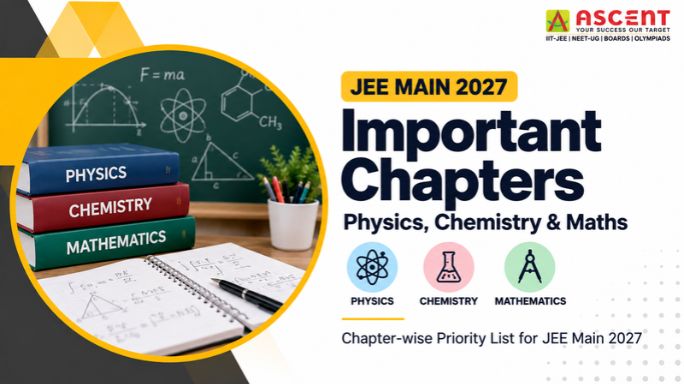

With a few months left before the first session of JEE Main, every aspirant faces the same question: where should the remaining time go? The syllabus is huge, and treating every topic with equal weight is the fastest way to run out of time. The smarter approach is to identify the JEE Main 2027 Important Chapters, master them first and then move outwards to the rest of the syllabus.
This guide lists the chapters that matter most in Physics, Chemistry and Mathematics, explains why each one deserves attention, and shows how to turn this list into a practical plan. The picks are based on the questions that have appeared repeatedly in recent JEE Main sessions, the weight each unit carries in the revised syllabus and how much effort each chapter needs relative to the marks it can return.
Why Chapter Prioritisation Works in JEE Main
In the recent pattern, JEE Main has 75 questions, 25 from each subject, for a total of 300 marks. Each subject has 20 multiple-choice questions and 5 numerical value questions, all compulsory, with four marks for a correct answer and negative marking for wrong ones.
Total Questions
Total Marks
Questions per Subject
MCQs + Numericals per Subject
With two sessions held around January and April, students get two chances, but the competition is intense and percentiles move sharply with just a few marks.
Here is the key insight: a relatively small group of chapters produces a large share of questions year after year. If your preparation is strong in these chapters, you secure a solid base score, and every extra topic you cover adds marks on top of it. Studying the important chapters for JEE Main 2027 first is not a shortcut. It is the order in which a sensible student should build preparation.
💡 Quick note: The syllabus was revised from 2024 onwards and several topics were dropped, such as mathematical reasoning in Maths and surface chemistry, polymers and environmental chemistry in Chemistry. Always cross-check with the official NTA information bulletin for JEE Main 2027 before finalising your list — this breakdown of the JEE Main 2027 syllabus and exam pattern is a good reference to keep alongside.
Physics: Key Chapters to Prioritise
Physics in JEE Main tests both concepts and calculation speed. Some chapters are short but highly scoring, while others are long and conceptually deep. The best results come from balancing both types.
How to approach Physics chapters
⚛️ Physics Approach
Mechanics as a whole, including kinematics, laws of motion and work-energy, is the foundation for many other chapters. Even if a single mechanics chapter does not produce many questions alone, weak basics there will hurt your performance in rotation, gravitation and SHM.
Chemistry: Key Chapters to Prioritise
Chemistry is often called the most scoring subject in JEE Main because questions take less time and many are directly based on NCERT. The subject splits naturally into physical, inorganic and organic chemistry, and each part needs a different method.
Physical Chemistry
Inorganic Chemistry
Inorganic chemistry rewards students who read NCERT closely. Many questions lift statements, exceptions and reactions almost directly from the textbook, so line-by-line reading and frequent revision are essential.
Organic Chemistry
How to approach Chemistry chapters
🧪 Chemistry Approach
Mathematics: Key Chapters to Prioritise
Mathematics is usually the most time-consuming section in JEE Main. Calculus and coordinate geometry carry significant weight, but algebra chapters produce a large number of quick, scoring questions too.
How to approach Mathematics chapters
📐 Mathematics Approach
How to Use This List of JEE Main Important Chapters 2027
Knowing the JEE Main important chapters 2027 is only useful if you turn the list into action. Here is a simple system:
Sort chapters into three groups
Rate every high-priority chapter honestly as strong, average or weak. Strong chapters need only revision and practice. Average chapters need focused problem-solving. Weak chapters need concept rebuilding from the basics.
Use the effort-to-marks rule
Some chapters return a lot of marks for little effort, such as units and dimensions, matrices, biomolecules and modern physics. Others, like rotational motion or permutations, take more time. Finish the quick-return chapters first so that your base score improves early, then invest steady time in the tougher ones.
Solve previous year questions chapter-wise
Previous year questions from recent JEE Main sessions are the best indicator of question style. Solve them chapter-wise after studying each topic — a subject-wise JEE Main book list helps you pick the right practice material — then attempt full shift papers under timed conditions. Because there are many shifts each year, you have a large bank of genuine questions to practise from.
Take regular mock tests and analyse them
Full-length mock tests show how well your chapter preparation translates into marks under pressure. After every test, list the chapters where you lost marks and the reason, whether a concept gap, a calculation error or poor time management. Feed this back into your weekly plan.
A Practical Timeline from Now to the Exam
Since the first session of JEE Main is usually held in January, students starting this plan in October 2026 need a focused approach.
Focus: Complete or strengthen all Very High priority chapters across subjects
Focus: Cover High priority chapters, chapter-wise PYQs, weekly part tests
Focus: Full revision, full-length mocks, Session 1 attempt
Focus: Fix weak areas from Session 1, cover remaining chapters, mocks for Session 2
If you are also preparing for board exams, align your board revision with the same chapters — this guide on managing school and JEE preparation together shows how. Most of the important chapters for JEE Main 2027 are also major units in the Class 11 and 12 board syllabus, so the effort counts twice.
Common Mistakes When Selecting Chapters
Role of Expert Guidance in Chapter Planning
Identifying important chapters is easier with someone who has watched exam trends closely for years. Experienced teachers can tell you which subtopics within a chapter deserve the most time, how question styles are changing and where students usually lose marks. Regular test series, daily practice problems and doubt sessions turn that guidance into measurable progress. For students in Udaipur and nearby cities, a structured JEE classroom programme in Udaipur with consistent testing can make it much easier to cover the JEE Main 2027 Important Chapters thoroughly and on time.
Frequently Asked Questions
Which subject is the most scoring in JEE Main?
For most students, chemistry is the most scoring because questions are shorter and many are based directly on NCERT. However, the best percentile comes from balanced performance across all three subjects.
Can I skip some chapters for JEE Main 2027?
You can de-prioritise a few low-weight chapters if time is short, but avoid skipping high-priority chapters. Focus first on the important chapters for JEE Main 2027 and then cover the rest as time allows.
Are Class 11 chapters important for JEE Main?
Yes. Class 11 contributes a significant share of questions, especially in mechanics, physical chemistry, coordinate geometry and algebra. Ignoring it is one of the costliest mistakes.
How many times should I revise important chapters?
Aim for at least three complete revisions of the high-priority chapters before the exam, with a short formula and reaction revision every week.
Final Thoughts
JEE Main is not won by studying everything equally. It is won by studying the right chapters deeply, practising them under timed conditions and revising them until they become second nature. Use this list of JEE Main 2027 Important Chapters as your starting map, review your progress every week, and keep refining your plan with each mock test. With disciplined effort over the coming months, a strong percentile is well within reach.
Ready to turn this chapter map into marks?
Join a guided JEE programme with expert faculty, daily practice, and a structured testing system.