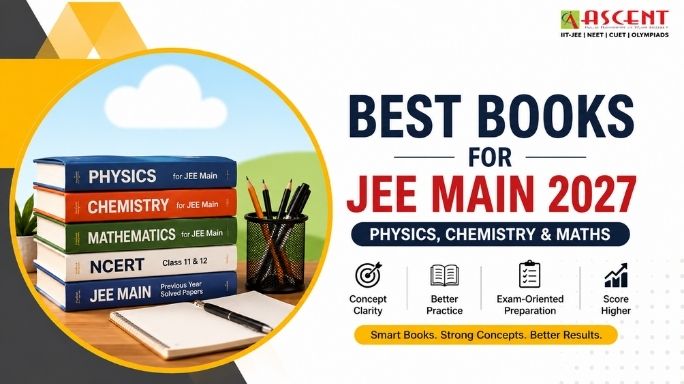

Choosing the right study material can make a significant difference in your JEE preparation. With hundreds of books available and countless recommendations across forums, social media, and YouTube, students preparing for JEE Main 2027 can easily feel confused about which resources are actually worth using.
This guide simplifies the process with a practical, subject-wise list of the Best Books for JEE Main 2027, selected to help students build strong concepts, improve problem-solving skills, and practise questions relevant to the JEE Main level. Whether you are starting your preparation in Class 11, studying in Class 12, or preparing for another attempt, the goal should not be to collect as many books as possible — choose a few reliable resources and use them consistently alongside mock tests and previous year questions.
Why the Right Book List Matters for JEE Main 2027
One of the most common mistakes JEE aspirants make is switching between too many books. Some resources may be too advanced for beginners, while others may not provide enough practice for competitive-level problem-solving.
NCERT textbooks provide an important foundation for JEE Main preparation, particularly for understanding core concepts and strengthening syllabus fundamentals. However, students also need sufficient numerical and application-based practice to improve their ability to solve questions accurately within the available time. A practical preparation strategy follows a layered approach:
|
1
|
Start with NCERT and your classroom notes to understand the fundamentals. |
|
2
|
Use one reliable reference book to strengthen concepts. |
|
3
|
Practise chapter-wise questions to improve problem-solving skills. |
|
4
|
Solve JEE Main Previous Year Questions (PYQs) to understand question patterns and difficulty levels. |
|
5
|
Take regular mock tests to improve speed, accuracy, and time management. |
Students looking for structured academic guidance can also explore IIT-JEE Main & Advanced classroom programmes in Udaipur to understand how organised study material, testing, and doubt-solving can support JEE preparation — and if you haven’t yet mapped out the syllabus itself, this overview of the expected JEE Main 2027 syllabus and exam pattern is a useful starting point before picking books.
Best Physics Books for JEE Main
Physics is a subject where conceptual clarity and regular problem-solving need to go hand in hand. Choosing the right books early can help students develop a stronger understanding of concepts and become more confident while solving numerical problems.
Start with NCERT Physics for Classes 11 and 12 to understand fundamental concepts, definitions, and formulas covered in the syllabus. For deeper concept building, Concepts of Physics by H.C. Verma remains a widely used resource among JEE aspirants — its explanations and problems help students develop a better understanding of topics such as Mechanics, Thermodynamics, Waves, Electricity, and Modern Physics.
For structured and exam-oriented practice, the Understanding Physics series by D.C. Pandey provides topic-wise questions that allow students to gradually improve their problem-solving ability.
💡 Keep it JEE Main-focused: Students preparing primarily for JEE Main should focus on resources that match the examination level rather than spending excessive time on highly advanced problems. Books such as I.E. Irodov may be useful as optional resources for students also preparing seriously for JEE Advanced, but they are not essential for a JEE Main-focused strategy.
📘 Recommended Physics Books
✓ NCERT Physics — Classes 11 and 12
✓ Concepts of Physics — H.C. Verma
✓ Understanding Physics — D.C. Pandey
✓ Chapter-wise JEE Main Previous Year Questions (PYQs)
Best Chemistry Books for JEE Main
Chemistry preparation becomes easier when students approach it as three distinct sections — Physical, Organic, and Inorganic Chemistry. Each section requires a slightly different study strategy.
|
🧫
Physical Chemistry Start with NCERT for fundamentals. O.P. Tandon’s Physical Chemistry builds concepts further, while P. Bahadur’s Numerical Chemistry sharpens calculation and application. N. Awasthi works well for extra problem practice. |
🧬
Organic Chemistry Build a clear understanding of reaction mechanisms first. Study NCERT carefully, use O.P. Tandon’s Organic Chemistry for concepts, and M.S. Chouhan for extensive problem-solving practice. |
⚗️
Inorganic Chemistry NCERT should remain the primary resource here — read carefully and revise regularly. J.D. Lee’s Concise Inorganic Chemistry is an optional reference, never a replacement for NCERT. |
Maintaining a separate formula sheet and reaction chart throughout the year can also make final revision faster and more organised. Combining NCERT with one reliable practice resource for Physical Chemistry and one for Organic Chemistry can provide balanced preparation without creating unnecessary study overload.
🧪 Recommended Chemistry Books
✓ NCERT Chemistry — Classes 11 and 12
✓ Physical Chemistry — O.P. Tandon
✓ Numerical Chemistry — P. Bahadur
✓ Problems in Physical Chemistry — N. Awasthi
✓ Organic Chemistry — O.P. Tandon
✓ Advanced Problems in Organic Chemistry — M.S. Chouhan
✓ Concise Inorganic Chemistry — J.D. Lee (optional reference)
✓ Chapter-wise JEE Main Previous Year Questions (PYQs)
Best Maths Books for JEE Main
Mathematics is a subject where consistent practice often matters more than the number of books a student owns. The right resources, however, can make daily practice more systematic and help students progress from basic concepts to exam-level problems.
Start with NCERT Mathematics for Classes 11 and 12, along with NCERT Exemplar, to strengthen fundamental concepts and practise a variety of questions. For structured chapter-wise practice, Cengage Mathematics by G. Tewani is a popular resource offering problems ranging from foundational to more advanced levels.
R.D. Sharma’s Objective Mathematics can be useful for additional objective-style practice, while Arihant’s Skills in Mathematics series provides topic-specific practice across areas such as Algebra, Coordinate Geometry, Calculus, and Trigonometry. The key is not to solve every available book — choose one primary practice resource and work through it consistently while solving JEE Main PYQs alongside your preparation.
📐 Recommended Maths Books
✓ NCERT Mathematics — Classes 11 and 12
✓ NCERT Exemplar
✓ Cengage Mathematics — G. Tewani
✓ Objective Mathematics — R.D. Sharma
✓ Skills in Mathematics — Arihant
✓ Chapter-wise JEE Main Previous Year Questions (PYQs)
Students who want to combine these resources with a more structured preparation approach can read more about JEE preparation coaching options in Udaipur and the role of regular testing, academic guidance, and doubt-solving in competitive exam preparation.
Quick Reference: Subject-Wise JEE Main Book List
| Subject | Recommended Books | Best For |
|---|---|---|
| Physics | NCERT, H.C. Verma, D.C. Pandey, PYQs | Concept building and graded problem practice |
| Chemistry | NCERT, O.P. Tandon, P. Bahadur, N. Awasthi, M.S. Chouhan, PYQs | Concepts, numericals, and reaction-based practice |
| Mathematics | NCERT, NCERT Exemplar, Cengage, R.D. Sharma, Arihant, PYQs | Chapter-wise practice and speed building |
Don’t Ignore JEE Main Previous Year Questions
While reference books are important, JEE Main Previous Year Questions (PYQs) should be an essential part of your preparation strategy. Solving PYQs can help students:
- Understand how concepts are tested in the actual examination.
- Identify frequently tested topics and question styles.
- Become familiar with the expected difficulty level.
- Improve speed and accuracy.
- Evaluate whether they can apply concepts under time pressure.
Instead of waiting until the syllabus is complete, students can start solving chapter-wise PYQs after finishing each topic. This creates a direct connection between concept learning and exam-oriented practice. Closer to the examination, full-length previous year papers can be attempted under timed conditions to develop better time management and examination confidence — a habit reinforced by systematic strategies followed by consistent JEE scorers.
How to Use This Book List Without Getting Overwhelmed
Owning the right books is only half the job. How consistently you use them ultimately determines how useful they are for your preparation. Here are a few practical habits to follow:
|
1
|
Build the Basics First Read NCERT and review your classroom notes before moving to reference books. |
|
2
|
Choose One Main Practice Book Avoid switching between multiple authors for the same chapter. Complete one reliable resource before adding another. |
|
3
|
Solve PYQs Chapter-Wise After completing a chapter, practise relevant JEE Main previous year questions to understand how the topic appears in the examination. |
|
4
|
Start Timed Practice Gradually Once your concepts are reasonably strong, begin solving practice sets within a fixed time limit. |
|
5
|
Maintain a Mistake Notebook Record conceptual errors, calculation mistakes, and questions you found difficult. Review this notebook regularly. |
|
6
|
Take Regular Mock Tests Mock tests help identify weak areas while improving speed, accuracy, and examination strategy. |
|
7
|
Keep Final Revision Simple During the final weeks, focus primarily on notes, formula sheets, reaction charts, your mistake notebook, PYQs, and mock test analysis rather than starting new books. |
A disciplined study routine supported by the right resources is one of the key elements of successful preparation — much like the structure followed in this realistic daily routine of IIT JEE aspirants.
Frequently Asked Questions
Is NCERT enough for JEE Main 2027?
NCERT provides an important foundation for JEE Main preparation and should be studied carefully. However, students should also practise numerical and application-based questions using suitable reference books, PYQs, and mock tests to develop stronger problem-solving skills.
How many books should I use per subject?
There is no fixed number, but most students do not need a large collection of books. One resource for concept building, one reliable source for problem practice, and chapter-wise PYQs can be sufficient when used consistently. The quality and depth of practice matter more than the number of books completed.
Should droppers use a different book list?
The core resources can remain largely the same. However, droppers who already have strong conceptual foundations may spend more time on PYQs, advanced problem-solving, mock tests, and detailed analysis of their weak areas instead of repeatedly studying basic theory.
Are previous year questions important for JEE Main 2027?
Yes. Previous year questions help students understand how concepts have been tested in earlier JEE Main examinations. They are useful for identifying question patterns, evaluating preparation levels, and improving problem-solving speed.
Should I buy all the books mentioned in this list?
No. This list provides options, not a compulsory shopping list. Students should select books according to their current preparation level, learning style, and guidance from teachers. Completing a few carefully selected resources is usually more effective than partially solving many books.
Key Takeaways
✓ NCERT is the non-negotiable foundation for every subject — reference books only build on top of it.
✓ One primary practice resource per subject, used consistently, beats five half-finished books.
✓ Chapter-wise PYQs and regular mock tests should run alongside your books, not after them.
✓ During final revision, lean on your own notes and mistake log rather than starting new material.
Final Thoughts
There is no single “perfect” book list that works identically for every JEE aspirant. The right combination depends on your current preparation level, available time, stronger and weaker subjects, and comfort with numerical and concept-based questions.
What matters most is following a focused strategy rather than collecting every recommended resource. Use this list of the Best Books for JEE Main 2027 as a practical starting point, select the resources that suit your preparation needs, and combine them with consistent revision, JEE Main PYQs, and regular mock tests. Students preparing for JEE Main 2027 can also benefit from structured study material, regular testing, doubt-solving sessions, and experienced academic guidance — this look at why many students choose guided coaching over self-study for JEE explains how a structured learning environment can strengthen concepts and support consistent progress throughout the preparation journey.
Want expert guidance on which books actually fit your level?
Join a guided JEE programme with structured study material, mentorship, and regular testing built in.