
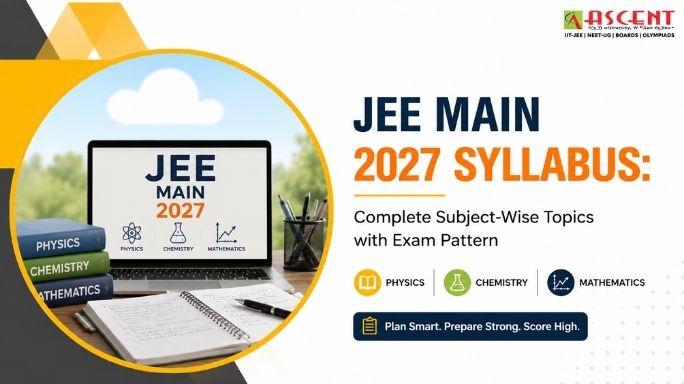

Before creating a JEE preparation timetable, students need clarity on two things: what they need to study and how the examination is structured. This guide provides an overview of the expected JEE Main 2027 Syllabus for Physics, Chemistry, and Mathematics, along with the exam pattern based on the latest available structure — so you can organise your preparation, identify important areas, and build an effective study plan.
⚠️ Important Note: The National Testing Agency (NTA) has not yet released the official JEE Main 2027 syllabus or information bulletin. The syllabus topics and exam pattern discussed in this article are based on the latest available JEE Main syllabus and examination structure. Students should verify all details with the official JEE Main 2027 information bulletin once it is released by NTA.
Understanding the Expected JEE Main 2027 Exam Pattern
Until the official JEE Main 2027 information bulletin is released, students can use the latest available JEE Main exam structure as a reference for preparation. For Paper 1 (B.E./B.Tech), JEE Main assesses students across three subjects, and based on the latest available examination structure, each subject carries equal importance in the overall paper.
|
⚛️
Physics |
🧪
Chemistry |
📐
Mathematics |
Students are tested through a combination of multiple-choice questions (MCQs) and numerical value questions. The examination is conducted as a Computer-Based Test (CBT), making regular online mock-test practice particularly useful for students preparing for the exam. The exact number of questions, marking scheme, negative marking rules, and other examination instructions for JEE Main 2027 should be confirmed from the official NTA information bulletin once it becomes available.
Students preparing for both JEE Main and JEE Advanced can explore structured IIT-JEE classroom programmes to understand how structured preparation, study material, regular testing, and doubt-solving can support their preparation journey.
Physics Syllabus for JEE Main 2027
Physics is one of the three core subjects in the JEE Main 2027 Syllabus. Preparation generally covers topics taught across Classes 11 and 12, with questions testing conceptual understanding as well as the ability to apply concepts to numerical problems. Based on the latest available syllabus structure, students can expect preparation to cover major areas such as Mechanics, Thermodynamics, Electrodynamics, Optics, Waves, and Modern Physics.
Key Physics Topics
| Unit | Key Topics |
|---|---|
| Units and Measurements | Units, Dimensions, Measurement of Errors |
| Mechanics | Kinematics, Laws of Motion, Work, Energy and Power, Rotational Motion, Gravitation |
| Properties of Matter | Properties of Solids and Liquids |
| Thermodynamics | Thermodynamics and Kinetic Theory of Gases |
| Oscillations and Waves | Simple Harmonic Motion, Waves |
| Electrostatics | Electric Charges and Fields, Electrostatic Potential and Capacitance |
| Current Electricity | Electric Current, Resistance, Electrical Circuits |
| Magnetism | Magnetic Effects of Current and Magnetism |
| Electromagnetic Induction | Electromagnetic Induction and Alternating Current |
| Electromagnetic Waves | Properties and Applications of Electromagnetic Waves |
| Optics | Ray Optics and Wave Optics |
| Modern Physics | Dual Nature of Matter and Radiation, Atoms and Nuclei |
| Electronics | Electronic Devices |
| Experimental Skills | Measurement and practical concepts specified in the syllabus |
Students should practise numerical problems regularly rather than relying only on theory. Chapter-wise previous year questions can also help students understand how different Physics concepts have been tested in earlier JEE Main papers.
Chemistry Syllabus for JEE Main 2027
Chemistry preparation for JEE Main can be broadly divided into three areas — each requiring a different preparation approach. Physical Chemistry involves conceptual understanding and numerical problem-solving, Organic Chemistry requires clarity of fundamental principles and reactions, while Inorganic Chemistry requires careful study and regular revision.
|
🧫
Physical Chemistry
|
⚗️
Inorganic Chemistry
|
🧬
Organic Chemistry
|
Students should treat the latest official syllabus as their primary checklist and avoid relying solely on older reference books, as syllabus topics can be revised between examination cycles. For Chemistry preparation, NCERT textbooks remain an important resource, particularly for building syllabus-level understanding. Reference books and problem sets can then be used for additional practice based on individual preparation needs.
Students exploring how the right coaching environment supports JEE preparation in Udaipur will find that guided doubt-solving makes a measurable difference in Chemistry, where small conceptual gaps compound quickly.
Mathematics Syllabus for JEE Main 2027
Mathematics requires consistent practice because many questions involve multiple calculation steps and the application of more than one concept. The expected Mathematics syllabus covers major areas including Algebra, Calculus, Coordinate Geometry, Vector Algebra, Three-Dimensional Geometry, Statistics, Probability, and Trigonometry.
Key Mathematics Topics
| Unit | Key Topics |
|---|---|
| Sets and Functions | Sets, Relations and Functions |
| Algebra | Complex Numbers, Quadratic Equations, Matrices and Determinants |
| Permutations & Combinations | Fundamental Principle of Counting, Permutations, Combinations |
| Binomial Theorem | Binomial Expansion and Applications |
| Sequences and Series | Arithmetic and Geometric Progressions |
| Calculus | Limits, Continuity, Differentiability, Applications of Derivatives |
| Integral Calculus | Indefinite and Definite Integrals, Applications of Integrals |
| Differential Equations | Formation and Solution of Differential Equations |
| Coordinate Geometry | Straight Lines, Circles and Conic Sections |
| Three-Dimensional Geometry | Coordinates and Geometry in Three Dimensions |
| Vector Algebra | Vectors and Their Applications |
| Statistics and Probability | Measures of Dispersion and Probability |
| Trigonometry | Trigonometric Identities and Equations |
Students should combine conceptual learning with regular timed problem-solving. Since Mathematics can require considerable calculation time, practising questions under exam-like time limits can help improve both speed and accuracy.
“Mathematics rewards students who practise under exam-like time pressure — speed and accuracy are trained, not assumed.”
— A recurring insight from JEE mentors
Will the JEE Main 2027 Syllabus Change?
As of now, the official JEE Main 2027 syllabus has not been released by NTA. Therefore, it is not possible to confirm whether topics will be added, removed, or modified for the 2027 examination. Students beginning their preparation early can use the latest officially available syllabus as their working framework. Once NTA publishes the JEE Main 2027 syllabus, they should compare it carefully with their existing preparation checklist and make any necessary adjustments.
💡 Reality check: This is particularly important for students using older books or question banks, as these resources may contain topics no longer part of the latest syllabus. Rather than spending time on outdated material, always align your final preparation with the official syllabus published for your examination year — and if you’re also weighing it against the advanced-level exam, this comparison of how JEE Main and JEE Advanced differ in pattern and difficulty is worth reading early.
How to Study the JEE Main Syllabus with the Exam Pattern
Treating the syllabus and exam pattern as two completely separate parts of preparation can make planning less effective. The syllabus tells you what to study, while the exam pattern tells you how your preparation may be assessed. Studying both together helps students decide:
- How to divide preparation time among Physics, Chemistry, and Mathematics.
- How much numerical problem-solving practice is required.
- How to balance conceptual learning with question practice.
- How to prepare for different question formats.
- How to manage time during a computer-based examination.
Students should first build strong fundamentals across the complete syllabus rather than skipping chapters solely because they appeared less frequently in previous papers. Previous year question trends can be useful for prioritising revision, but they should not be treated as a guarantee of how many questions will appear from a particular chapter in JEE Main 2027 — a month-by-month structured study plan built around the full syllabus makes this balancing act far easier to sustain.
How to Prioritise Chapters for JEE Main 2027
Students often search for “high-weightage chapters” to decide where to focus their preparation. While analysing previous year papers can provide useful insights, chapter-wise weightage can vary between different sessions and shifts. A better approach is to classify chapters into three categories:
|
1
|
Strong Chapters Topics where your concepts are already clear and your practice-test accuracy is consistently high. Revise them regularly so they remain scoring areas. |
|
2
|
Weak Chapters These require additional conceptual study, doubt-solving, and targeted problem practice. Addressing weak areas early can prevent gaps from affecting later chapters. |
|
3
|
Frequently Tested Topics from Previous Papers Use previous year papers to identify recurring concepts and question styles. Give these topics sufficient revision time while continuing to cover the complete prescribed syllabus. |
This approach is more reliable than depending entirely on a fixed “high-weightage chapter” list, since the distribution of questions can change from one JEE Main session or shift to another. Students can also explore systematic strategies for cracking JEE for additional insights into developing a well-rounded preparation approach.
Preparation Tips Based on the JEE Main Syllabus and Exam Pattern
|
1
|
Create a Master Syllabus Checklist Convert the complete syllabus into a chapter-wise checklist. Mark a chapter complete only after studying the concepts, solving practice questions, and reviewing your mistakes. |
|
2
|
Solve Chapter-Wise Previous Year Questions After completing a topic, practise relevant JEE Main previous year questions to understand how concepts have been tested and identify gaps. |
|
3
|
Take Regular Mock Tests As syllabus coverage improves, include full-length timed mock tests to get comfortable with the exam format and improve time management. |
|
4
|
Analyse Every Mock Test Don’t focus only on the final score. Review incorrect answers, unanswered questions, calculation mistakes, and questions that took too much time. |
|
5
|
Maintain Short Notes and Formula Sheets Prepare concise revision notes for formulas, reactions, important concepts, and recurring mistakes — especially useful during final revision. |
|
6
|
Track Subject-Wise Performance Monitor your accuracy and time spent separately for Physics, Chemistry, and Mathematics to identify where your strategy needs adjustment. |
|
7
|
Revise Consistently Instead of leaving revision until the final month, schedule regular revision cycles throughout preparation — much like the structure in this realistic daily routine followed by JEE aspirants. |
Frequently Asked Questions
Has the official JEE Main 2027 syllabus been released?
No. As of now, NTA has not released the official JEE Main 2027 syllabus and information bulletin. Students can use the latest officially available JEE Main syllabus as a preparation reference and should check the official 2027 syllabus once it is published.
Will the JEE Main syllabus change for 2027?
It is not possible to confirm until NTA releases the official JEE Main 2027 syllabus. Students should avoid assuming the syllabus will remain exactly the same and should verify any changes once the official notification becomes available.
Is the JEE Main syllabus the same as the JEE Advanced syllabus?
The two examinations have considerable overlap in Physics, Chemistry, and Mathematics, but their syllabi and question approaches should not be assumed to be identical. Students preparing for both should refer separately to the official syllabus prescribed for each exam.
How should I start preparing for the JEE Main 2027 syllabus?
Start by using the latest official syllabus as a working checklist. Build strong fundamentals, complete chapter-wise practice, solve previous year questions, and gradually introduce timed mock tests. Update your preparation plan when the official JEE Main 2027 syllabus is released.
Should I prepare only high-weightage chapters for JEE Main 2027?
No. Previous year trends can help prioritise revision, but chapter-wise question distribution may vary between sessions and shifts. Students should aim to cover the complete prescribed syllabus and use past-paper trends only as a supplementary prioritisation tool.
Key Takeaways
✓ The official JEE Main 2027 syllabus has not yet been released — treat the latest available syllabus as a working reference.
✓ Study the syllabus and exam pattern together, not as separate checklists.
✓ Classify chapters as strong, weak, or frequently tested to prioritise revision sensibly.
✓ A consistent routine of checklists, previous year questions, mock tests, and revision cycles matters more than chasing a fixed weightage list.
Final Thoughts
Understanding the JEE Main 2027 Syllabus and expected exam pattern can give students a clear framework for organising their preparation. However, because NTA has not yet published the official 2027 syllabus and information bulletin, students should treat the latest available syllabus as a working reference rather than assuming that every detail will remain unchanged.
Build your preparation around strong conceptual foundations, regular problem-solving, previous year questions, mock tests, and consistent revision. Once the official JEE Main 2027 syllabus is released, compare it with your preparation checklist and make any necessary adjustments. Students who prefer a structured learning environment can read about why many students choose guided coaching over self-study for JEE, where study material, daily practice, doubt-solving, periodic testing, and performance tracking come together in one system.
Ready to turn your syllabus into a structured plan?
Join a guided JEE programme with expert mentors, structured testing, and a proven study system.