
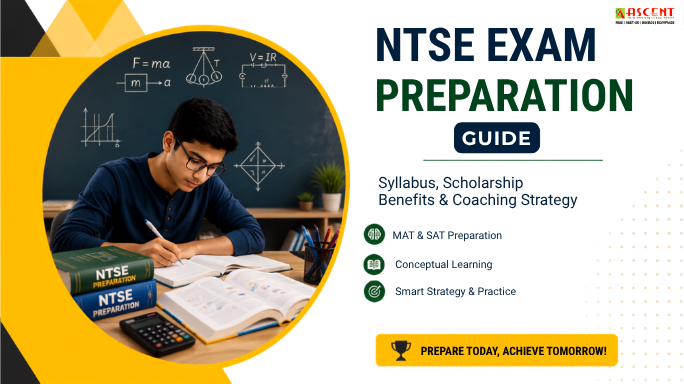

The National Talent Search Examination (NTSE) has historically been one of India’s prominent national-level talent identification and scholarship programmes for school students. However, students and parents should be aware that the examination has not been conducted since 2021, and there is currently no official NCERT notification confirming an NTSE 2026 examination.
This guide explains the traditional NTSE eligibility, examination structure, syllabus, and preparation approach so students can understand the skills involved and prepare systematically if the examination is officially reintroduced.
⚠️ Important: NTSE examination dates, registration, eligibility, syllabus and examination pattern should not be assumed until officially announced by NCERT. Students should check the latest official notification before making examination-specific plans.
Why Students Should Understand NTSE
The National Talent Search Scheme was designed to identify and nurture academically talented students. Historically, the programme combined a competitive examination with scholarship support and a longer-term nurturing component.
Even when an examination is not currently scheduled, understanding the traditional NTSE preparation approach can help students develop useful academic skills, particularly logical reasoning, conceptual understanding, problem-solving and disciplined study habits.
Students should, however, distinguish between preparation skills and an officially announced examination. Preparation for NTSE should not be presented as preparation for a confirmed 2026 examination until NCERT publishes an official notification.
1. Understanding the Traditional NTSE Exam Structure
Historically, NTSE selection followed a two-stage structure:
| Stage | Level | Main Components |
| Stage 1 | State/UT level | Mental Ability Test (MAT) + Scholastic Aptitude Test (SAT) |
| Stage 2 | National level | Mental Ability Test (MAT) + Scholastic Aptitude Test (SAT) |
The traditional scheme involved state/UT-level selection followed by a national-level examination conducted by NCERT.
Because the examination has not been conducted since 2021, students should not assume that the historical pattern, qualifying marks, dates, or selection process will remain unchanged if the scheme is reintroduced.
2. Understanding the Scholarship Benefit
The NTSE scholarship was an important part of the National Talent Search Scheme. Historical NTSE documentation records scholarship support for selected students pursuing education in areas including science, social science and professional courses.
However, students should avoid relying on historical scholarship amounts or eligibility conditions for a future NTSE examination. Any scholarship amount, duration, eligibility criteria or number of awards for a future examination would need to be confirmed through an official NCERT notification.
The educational value of preparing for a talent-search examination can also include:
- Stronger logical reasoning skills
- Better conceptual understanding
- More disciplined study habits
- Greater familiarity with competitive examination environments
- Improved problem-solving ability
These skills can support students in other academic and competitive examinations as well.
3. Traditional NTSE Syllabus Breakdown
Historically, NTSE preparation focused on two broad areas: Mental Ability Test (MAT) and Scholastic Aptitude Test (SAT).
🧠 Mental Ability Test (MAT)
MAT traditionally focused on reasoning and mental ability rather than direct school-syllabus recall. Preparation commonly involved areas such as:
- Analogies
- Classification
- Series
- Pattern recognition
- Logical reasoning
- Verbal reasoning
- Non-verbal reasoning
- Coding and decoding
- Relationships and sequences
The exact syllabus and question pattern should be confirmed from official material if NTSE is reintroduced.
📘 Scholastic Aptitude Test (SAT)
SAT historically assessed school-level academic knowledge across Science, Mathematics and Social Science.
The academic foundation was closely connected to the school curriculum, particularly Classes 9 and 10. This makes strong school-level conceptual understanding particularly important. Students should avoid treating competitive-exam preparation as completely separate from their regular studies.
For students looking to strengthen their academic foundation at an earlier stage, see Ascent Udaipur’s Best Foundation Courses in Udaipur for Classes 6 to 10.
4. NTSE Preparation Strategy
|
1
|
Start With Conceptual Clarity Do not begin preparation by collecting multiple books and question banks. First, make sure your school-level concepts are clear, particularly in Mathematics, Science, and Social Science. Once the fundamentals are strong, move towards more challenging questions and reasoning practice. |
|
2
|
Develop MAT Skills Through Regular Practice Reasoning ability improves through repeated exposure to different types of problems. Instead of attempting a large number of questions only before an examination, build a consistent practice routine. Even a short, focused session can help students become more familiar with patterns and improve their problem-solving approach. |
|
3
|
Strengthen SAT Preparation Alongside School Studies SAT preparation should complement regular academic study. When you study a chapter for school, focus on understanding the concepts rather than memorising answers. Then practise questions that require you to apply those concepts in unfamiliar situations. This approach allows school preparation and competitive-exam preparation to support each other instead of becoming two completely separate workloads. |
|
4
|
Practise Previous-Year Questions If and when an official examination is announced, students should use authentic previous-year papers and officially released sample material wherever available. Previous papers can help students understand question styles, difficulty levels, time requirements, frequently tested concepts, and areas requiring additional practice. Avoid treating old papers as a guarantee of the future examination pattern. |
|
5
|
Track MAT and SAT Performance Separately Students preparing using the historical NTSE structure should analyse their MAT and SAT performance independently. For example: MAT performance: Are reasoning questions taking too long? Are particular patterns causing repeated errors? SAT performance: Are mistakes caused by weak concepts, incomplete revision, or careless calculation? This gives students a clearer picture of where their preparation needs improvement. |
5. Common Mistakes NTSE Aspirants Should Avoid
|
1
|
Treating NTSE Preparation Like a Regular School Exam School examinations and competitive examinations require different approaches. School preparation builds the academic foundation, while competitive preparation also requires speed, application, and familiarity with unfamiliar question formats. |
|
2
|
Neglecting Mental Ability Practice Students with strong academic marks sometimes underestimate reasoning preparation. Regular MAT-style practice is important because reasoning questions require a different type of problem-solving approach from conventional textbook exercises. |
|
3
|
Starting Preparation Without Checking Official Updates This is particularly important now. Since NTSE has not been conducted since 2021, students should not rely on websites or coaching material claiming confirmed NTSE dates or registration details unless those details are supported by an official NCERT notification. |
|
4
|
Using Too Many Study Resources More books do not automatically produce better preparation. Choose a limited set of reliable resources and use them consistently. Too many books can divide attention and reduce the time available for revision and practice. |
|
5
|
Ignoring Regular School Studies A strong competitive-exam strategy should not unnecessarily weaken Class 9 or Class 10 academic performance. Maintain a balance between school studies, concept building and reasoning practice. |
6. Balancing Competitive Preparation With School
Students in Classes 9 and 10 already have substantial academic responsibilities. A practical approach is to integrate competitive preparation into the existing routine instead of creating an unrealistic second timetable. For example:
| Focus Area | What To Do |
| School study | Complete classroom learning, homework and syllabus revision. |
| MAT practice | Use short, focused sessions for reasoning questions. |
| SAT preparation | Strengthen the same Mathematics, Science and Social Science concepts being covered in school. |
| Weekly review | Identify topics that require additional practice and plan them into the following week. |
Students can also refer to Ascent Udaipur’s Effective Study Plan for Competitive Exams for broader guidance on organising competitive-exam preparation.
7. How Coaching Can Support NTSE Preparation
Coaching can be useful when students need structured practice, regular assessment and guidance on difficult concepts. A well-designed preparation programme can help students with:
- MAT reasoning practice
- Conceptual SAT preparation
- Regular assessments
- Previous-paper practice
- Doubt resolution
- Identification of weak areas
- Study planning
- Performance tracking
However, coaching should supplement a student’s own consistent practice rather than replace it.
Students and parents should evaluate a coaching programme based on teaching quality, academic support, assessment systems and the suitability of the programme for the student’s current level.
For broader guidance on developing effective academic habits, see 10 Habits of Successful Students You Need to Know to Crack Competitive Exams.
Key Takeaways
✓ NTSE has not been conducted since 2021 — treat this as skill-building preparation, not preparation for a confirmed 2026 exam.
✓ The traditional structure combined MAT (reasoning) and SAT (school-level academics) — strengthen both, not just one.
✓ Any future exam dates, syllabus, pattern or scholarship details should come only from an official NCERT notification.
“The most useful approach is to strengthen school-level concepts, practise reasoning regularly, analyse performance and maintain consistent study habits.”
The Bottom Line
NTSE has historically rewarded students with strong academic foundations, reasoning ability and disciplined preparation. Its traditional structure combined MAT and SAT-based assessment with a scholarship programme designed to identify and support talented students.
For students interested in NTSE-style preparation, the most useful approach is to strengthen school-level concepts, practise reasoning regularly, analyse performance and maintain consistent study habits.
However, because NTSE has not been conducted since 2021, students should not treat NTSE 2026 as a confirmed examination. Any future examination dates, eligibility rules, syllabus, pattern or scholarship details should be taken directly from an official NCERT announcement.
Frequently Asked Questions
Is NTSE 2026 confirmed?
No — NTSE has not been conducted since 2021, and there is currently no official NCERT notification confirming an NTSE 2026 exam.
Students and parents should check the latest official NCERT notification before making examination-specific plans, and should not rely on any website or coaching material claiming confirmed dates or registration details.
What was the traditional NTSE exam structure?
A two-stage structure — state/UT level, then national level — each with a Mental Ability Test (MAT) and Scholastic Aptitude Test (SAT).
Because the exam hasn’t been held since 2021, students should not assume the historical pattern, qualifying marks, or selection process will stay unchanged if it is reintroduced.
What is the difference between MAT and SAT in NTSE?
MAT tests reasoning and mental ability; SAT tests school-level academic knowledge in Science, Mathematics and Social Science.
MAT preparation covers analogies, classification, series, pattern recognition and verbal/non-verbal reasoning, while SAT is closely tied to the Class 9 and 10 school curriculum.
How should students prepare for NTSE without an official notification yet?
Focus on conceptual clarity, regular MAT reasoning practice, and SAT preparation alongside school studies.
Start with clear school-level fundamentals in Mathematics, Science and Social Science, build a consistent reasoning-practice routine, and track MAT and SAT performance separately to identify weak areas.
What is the biggest mistake NTSE aspirants make?
Starting preparation based on unconfirmed dates, or neglecting mental ability (MAT) practice in favour of only textbook study.
Students should also avoid using too many study resources and should not let competitive-exam preparation weaken their regular Class 9 or Class 10 academic performance.
Explore More Resources
|
🏫 Best Foundation Courses (Classes 6–10) Strengthen your academic foundation early, before reasoning-based exams. |
📅 Effective Study Plan for Competitive Exams Broader guidance on organising competitive-exam preparation. |
|
📌 10 Habits of Successful Students Academic habits that support NTSE, NEET, and JEE-style preparation alike. |
|
Ready to Strengthen Your Competitive Exam Preparation?
Ascent Udaipur can help students build stronger academic fundamentals, reasoning skills and structured preparation habits for competitive examinations.