
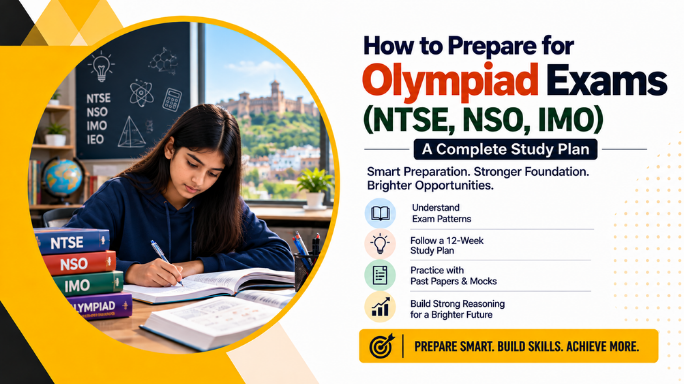

If your child is prepping for NTSE, NSO, IMO, or one of the many other Olympiad exams, you already know the syllabus overlaps with school — but the exam itself doesn’t feel like school at all. Olympiad papers reward speed, pattern recognition, and comfort with unfamiliar question formats far more than rote learning. If you’re wondering how to prepare for Olympiad exam success, here’s a study plan that actually accounts for that difference.
How to prepare for Olympiad exam: follow a 12-week plan — 4 weeks of NCERT concept revision, 4 weeks of Olympiad-pattern training, 2 weeks of timed sectional tests, and 2 final weeks of full mock tests with error-log review. Start by pulling the last 3 years of official sample papers for your exam.
⚠️ Important: Exam schedules, eligibility, and the status of NTSE change from year to year. Always confirm current details on the official NCERT (NTSE) and SOF (NSO, IMO) websites before registering.
12
Weeks in the complete study plan
4
Prep phases, from concepts to mocks
8–10
Full-length mocks in the final month
3
Years of past papers to start with
The Big Picture
Why Olympiad Exams Matter Beyond the Trophy
Olympiad exams do more than pad a resume. Strong NTSE performance can open the door to a national scholarship, and early exposure to Olympiad-style reasoning gives students a real head start on the analytical thinking that JEE and NEET demand later.
💡 Students who start Olympiad prep in Class 8–9 typically find the transition into serious JEE/NEET coaching far smoother in Class 11.
Step 01
Step 1: Know Your Exam — NTSE vs NSO vs IMO vs Other Olympiads
Not all Olympiads test the same thing, and treating them identically is the first mistake most students make — whether it’s NTSE preparation or a subject Olympiad like NSO.
🏅 NTSE (National Talent Search Examination)
Tests Mental Ability (MAT) plus a Scholastic Aptitude Test (SAT) covering science, maths, and social science — heavy on reasoning, not just recall.
🔬 NSO (National Science Olympiad)
Curriculum-based but with trickier, application-style questions than school exams.
➗ IMO (International Mathematics Olympiad — school level)
Pure problem-solving; expect logical puzzles alongside standard maths.
🌐 Other Olympiads (IEO, Cyber, GK)
Lower competitive intensity but useful for building exam-taking confidence early.
✅ Before you build a study plan, identify which exam(s) your child is registered for and pull the last 3 years of official sample papers — this single step saves weeks of misdirected effort.
Step 02
Step 2: Build a Realistic 12-Week Study Timeline
The simplest answer to how to prepare for Olympiad exam season without burnout is a 12-week runway — enough for focused preparation alongside regular schoolwork.
Weeks 1–4Concept revision. Rebuild NCERT-level fundamentals in the subjects the exam covers — no shortcuts here, since Olympiad questions twist basic concepts rather than replace them.
Weeks 5–8Pattern training. Move to Olympiad-specific question banks. This is where most of the ‘trick’ question types get familiar.
Weeks 9–10Timed sectional tests. Simulate exam conditions in 20–30 minute blocks per section to build speed under pressure.
Weeks 11–12Full mock tests plus error-log review — the single highest-leverage activity in the final stretch.
Step 03
Step 3: Master the Question Pattern, Not Just the Syllabus
Olympiad papers are famous for questions that look simple but have a twist buried in the wording. The most useful NSO IMO exam tips aren’t about more content — they’re about how you read the paper.
📖 Read the full question twice before attempting it — the twist is usually in one word.
✂️ Eliminate obviously wrong options first. This recovers more marks than another round of content revision in the final two weeks.
Step 04
Step 4: Practice With Past Papers and Mock Tests
Nothing replaces timed practice under real conditions. Aim for at least 8–10 full-length mock tests in the final month, followed each time by a structured error-log review.
📓 Your error log should record
→ What was missed
→ Why it was missed
→ Which concept needs a repeat pass
✔️ Students who maintain an error log consistently outperform those who simply attempt more papers without reviewing mistakes.
Avoid These
Common Mistakes Students Make While Preparing
❌ Starting Olympiad-specific practice too late, leaving no time to build speed
❌ Ignoring the mental ability/reasoning section because it feels ‘unteachable’
❌ Practising only easy questions and avoiding the harder ones that actually separate top ranks
❌ Skipping error-log review after mock tests
Building the Habit Early Pays Off Later
Students who train for Olympiad exams in middle school build exactly the reasoning muscle that JEE, NEET, and NTSE-linked scholarships reward later.
If your child is preparing for NTSE, NSO, IMO, or another Olympiad this year, knowing how to prepare for Olympiad exam day comes down to a structured 12-week plan — not last-minute cramming. That’s what separates a good score from a rank that opens doors.
Looking for structured Olympiad coaching in Udaipur or Olympiad coaching in Rajsamand and the surrounding districts? Ascent’s Olympiad batches follow exactly this pattern-first approach, with weekly mock tests and dedicated error-log review sessions.
FAQs
Frequently Asked Questions
Q. How to prepare for Olympiad exam in 3 months?
Follow a 12-week plan: concepts, pattern training, timed tests, then full mocks.
Spend weeks 1–4 on NCERT concept revision, weeks 5–8 on Olympiad question banks, weeks 9–10 on timed sectional tests, and weeks 11–12 on full mock tests with error-log review. Ascent Udaipur’s Olympiad batches follow this same structure.
Q. What is the difference between NTSE preparation and NSO/IMO preparation?
NTSE preparation needs heavy reasoning practice; NSO and IMO are more subject-focused.
NTSE combines a Mental Ability Test with a Scholastic Aptitude Test across science, maths and social science. NSO tests application-style science, and IMO tests maths problem-solving and logical puzzles.
Q. What are the best NSO IMO exam tips for the final weeks?
Read every question twice, eliminate wrong options, and review every mock.
Take 8–10 full-length mock tests in the final month and keep an error log of what you missed, why, and which concept needs revision.
Q. Which class is the best time to start Olympiad preparation?
Class 8–9 is ideal for building Olympiad-style reasoning.
Students who start in Class 8–9 usually find the move to JEE/NEET coaching in Class 11 much smoother.
Q. Is there Olympiad coaching in Udaipur for students from Rajsamand?
Yes — Ascent Udaipur offers Olympiad coaching for Udaipur, Rajsamand and nearby districts.
For families searching for Olympiad coaching in Rajsamand, Ascent’s Udaipur batches offer a pattern-first approach, weekly mock tests and dedicated error-log review sessions.
🎓 Ascent Udaipur
Olympiad Coaching in Udaipur & Rajsamand
NTSE, NSO and IMO preparation with weekly mock tests and dedicated error-log review sessions.